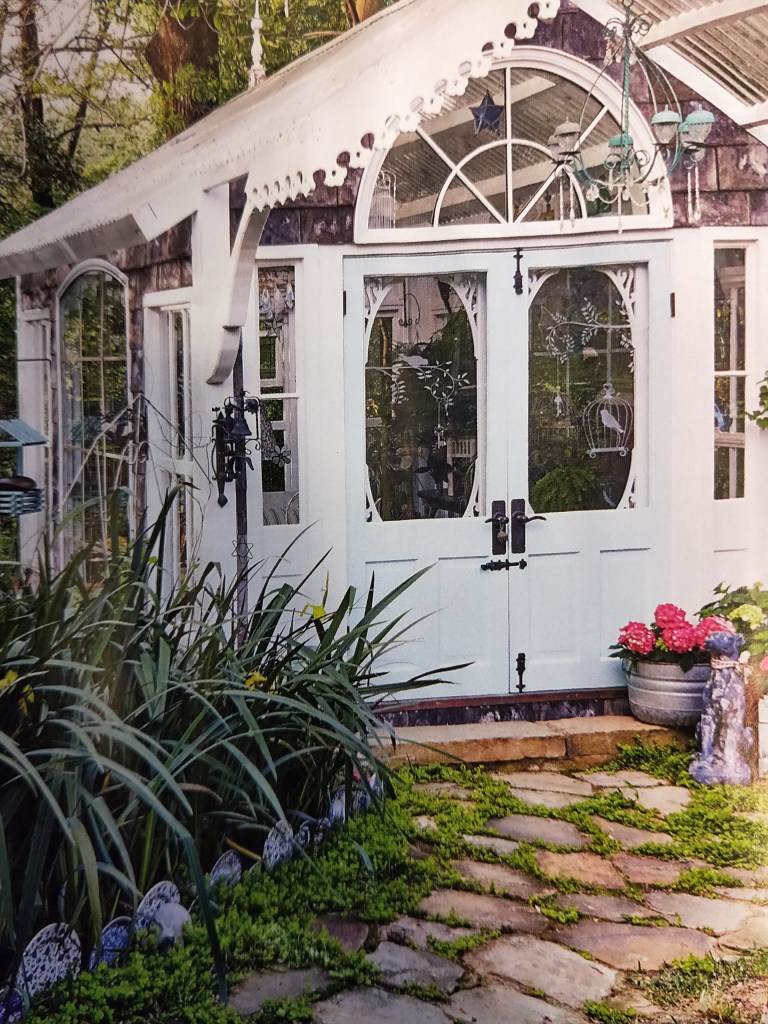
Every morning, as the sun rose, I wandered into the white-framed glass house of plants. The mornings were chilly but it was always warm in the little glass house that I learnt on my first visit was a greenhouse. There was always a tea set that looked like it was made of flowers on the glass table in the centre, two steaming cups waiting as she sat with her back to me. The little glass cottage was lined with benches and plants, smelling of spring and wet soil. As I moved closer to the table, the familiar smell of herbal tea and biscuits warmed me, pushing all of the cold to my cheeks and nose. Her scent was indistinguishable from the flowers. Though the little glass house was bright and colourful, she always wore black, black as dark as her waves of hair that stretched out behind her.
I had been going to the greenhouse for almost two years that morning, and over time I had noticed more and more about the place as I became more involved with it. I knew the names of the plants thriving and helped care for them. I could read the books that were collected on the portion of the north-western workbench where she kept her paperwork and even my handwriting could be seen in some of the ledgers she kept, documenting the progress of the greenhouse. The flooring had originally been all pebbles but she had put in large flat stones for me to move around on about a year ago because I often appeared in front of her bare foot and wasn’t as used to the rocks under my feet as she was, no matter how smooth they were. Across from her desk, the north-eastern corner of the workbenches had been cleared about four months after I first started visiting and now held my own projects. My plant projects weren’t as beautiful as hers but she always praised my efforts, encouraging me.
The western benches held the fruits of her labour, harvested products that she was using to create with. The windows had hooks in three lines, holding three thin ropes of dried herbs and flowers, held up by wooden pegs or twine. There were jars and tubes and parchment in what looked like a huge mess but both of us knew where to find everything. In the centre was a mortar and pestle. It was so heavy the first time I had used it but I could now reliably grind down herbs and spices for her and jar them up when needed. Little containers of salves and tinctures sat on the left near the spices on the right were beauty projects and large jars of prepared essential oils that would go into making beauty and cleaning products. She often let me take samples of them home but I never saw them sold in towns or heard about them so I wasn’t sure why she made so much. Stores of wax, wood, cloth and paper sat underneath the bench on shelving. I never saw her restock it but the supplies were never low.
The eastern benches held the carefully potted plants and the glass terrariums she created. She once told me that the miniature greenhouses she kept belonged to fairies that visited her, but I never saw one. Sometimes she would let me help light the candles in the opened ones. It was mostly ferns and flowers, the most colourful part of the greenhouse. Each season the flowers changed and she grew new ones. It was always misted with water and smelt like another world. The southern benches were split in half by the back door, just like our desks were, and on the left were small fruit and vegetable plants, such as strawberries and pots of lettuce and mini carrots. On the right was a staircase of wood were there were little terracotta pots holding more herbs that I had known existed before I started studying them. Underneath both workbenches were wooden boxes, stores of seeds and pots. More hooks ran across this side, in the wooden frames of the glass, holding all of the cared for tools that she had in the greenhouse.
The centre of the greenhouse was the place I knew most intimately. The first time I had wandered into the glass house, I was guided by the smell of something warm and sweet. The door had been open and there was an apple pie on the table, a brilliant tea set beside it. It was the same tea set we always used, created in the fashion of cupped flowers, as if I was drink out of a magnolia and the tea was poured out of a tulip. Telling others about how I had found the greenhouse had resulted in them insisting that I had been lured in by a witch, and so I stopped talking about it.
The table in the centre was circular and only large enough for two people to sit. Though she was always sitting alone, there had always been two chairs. The chairs were wooden, very basic in their design, a chair I could find anywhere, but there was something about the feel of them that told me there was significant memory and life embedded in them. The table was wooden but was much more eye-catching. The top was strangely glass, held in the frame of the wooden edge of the table and the middle was supported by the central pillar of the stand, where the legs forked out three ways. The wooden frame of the glass was delicately carved with flowers and leaves, all of types that I could recognise in the greenhouse when they were growing. The table was well cared for but just like the chairs, I could tell they were old. In the centre was a knitted mat of spiralling green and purple, where a single potted plant sat. Each day it was a different pot and plant, as if she were letting all of the smaller pots have some time on the table. The tea set sat on a wooden tray that had similar carving handiwork to the table. There were a few scratches on the table, and I knew where all of them were, often tracing them with my fingers while I talked. I was careful not to put anymore on there after the first time I accidentally clanked a spade against it when I’d hurriedly reached for a fresh brownie she’d brought me. I didn’t like tracing that scratch.
She herself didn’t blame me for the scratch on the table, she didn’t blame me for anything. Whenever I made a mistake, she always smiled softly at me and helped me correct it if I could. If I was upset about, she would pat the top of my head and pour me another warm cup of tea, bringing out more sweets she had baked. She would listen to me work through how I felt about my mistakes and how I would fix them and help without doing the work for me. She was always calm, with an air of warm and peaceful contentment. She moved in a quiet and ethereal way, as if she weren’t really human. But I think the difference between her and the others outside of the greenhouse was that she wasn’t fighting anything, not even time. She was enjoying each moment as it came.
“Lia,” is what she told me her name was when I finally asked after my third visit. It was short for ‘Amorellia’, a name not recognised at all by anyone in town. She never told me her family name, and it wasn’t written on anything in the greenhouse. I only knew her full first name because it was carved on the underside of table. There was an unspoken rule that I entered through the south door and never continued on through the northern door and so I didn’t have a chance to snoop about her house to satisfy my curiosities about what her family name might be.
Her voice was like crusted honey, sweet but with a nice huskiness to it, like the earth itself was speaking, vibrating through her. Her voice sounded like she was always musing, wrapping me in the hum of her words. It was always the same, never raised or lowered.


 Hopfield is Writing
Leave a reply to Writing Prompts using Writing Prompts – why even just writing a line is good – Hopfield is Writing Cancel reply