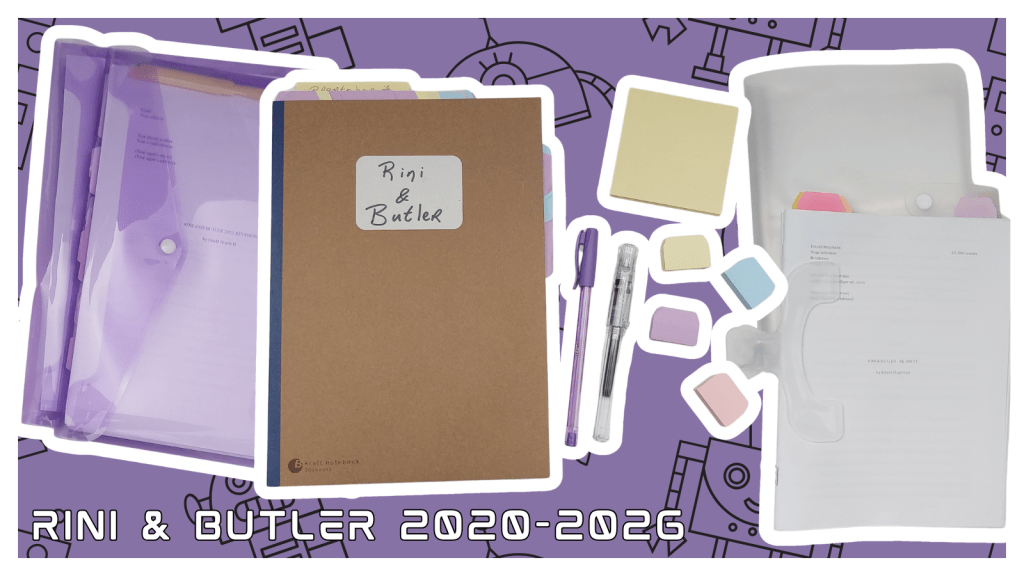
As February closed, so did Editary! (੭˃ᴗ˂)੭
This is the conclusion of the first set of writing blocks since I started them back in last October. I began planning them in September, having the passion re-ignited after watching Heart Breathings’ video on planning for Preptober: How I Prepare To Write A Novel in 30 Days 📆✍️ PREPTOBER PLANNING CHECKLIST.
It has been quite the journey writing Rini & Butler. I started writing Rini & Butler in 2020, during my first year of university. It was supposed to be a short story and ended up becoming a full-length first draft completed that same year.
Comparing the first draft to the current (sixth)
First Draft, 2020
51,258 words, 197 pages
Second Draft, 2021
51,984 words, 209 pages
Third Draft, 2021
51, 723 words, 204 pages
Fourth Draft, 2022
53,041 words, 209 pages
Fifth Draft, 2024
48,800 words, 151 pages
Sixth Draft, 2026
63, 257 words, 239 pages
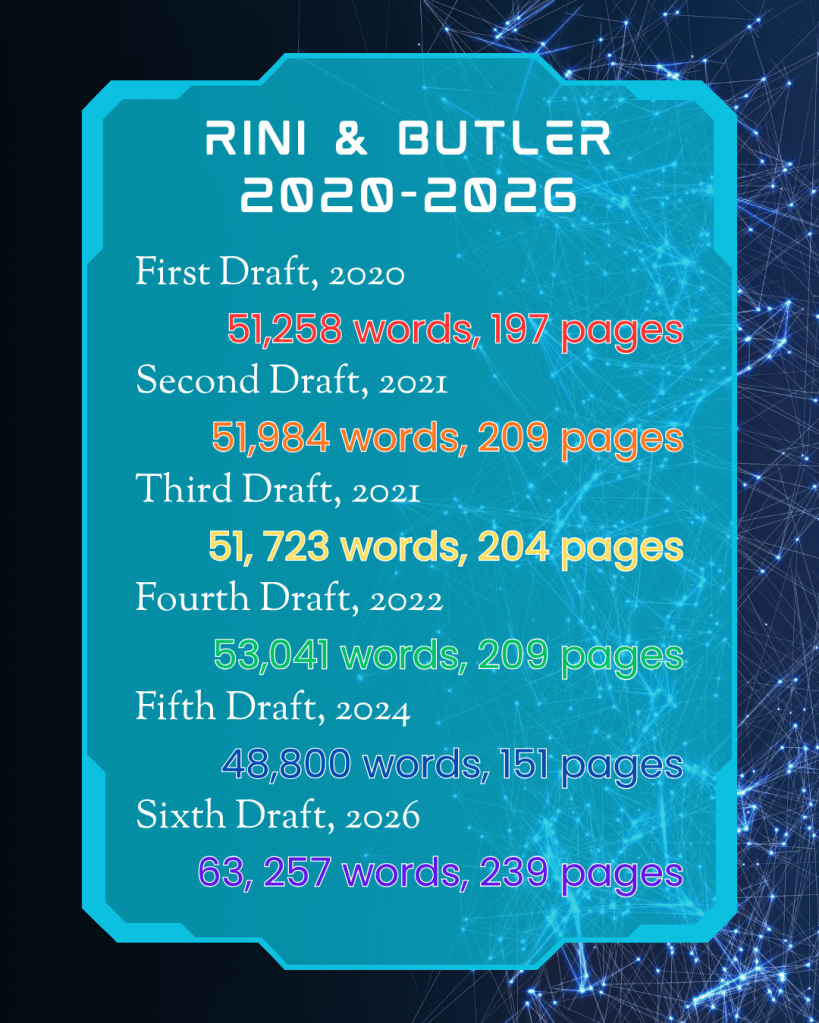
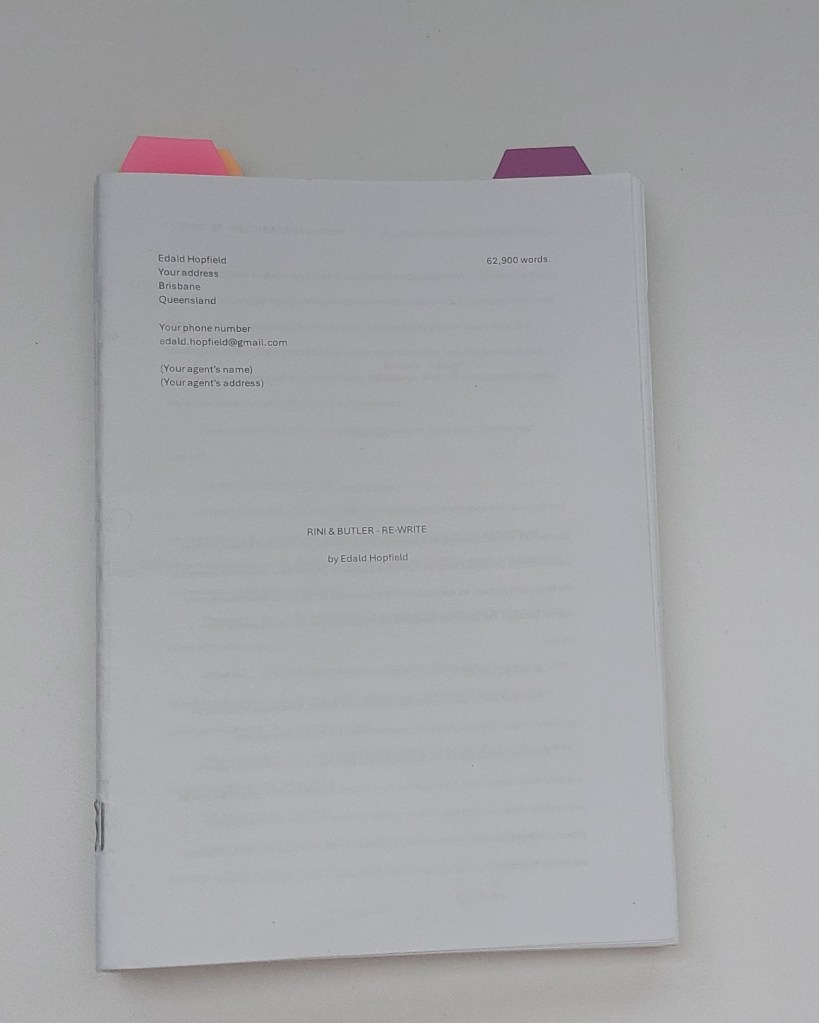
Between the first and fourth drafts, there was mostly line editing happening it looks like. 2025 was the first time I really did a structural overhaul of Rini & Butler (for this current edit). I cut out a bunch in the 2024 draft and also changed the tense from past to present.
For the sixth draft, my editing processes had completely evolved since 2024. When I was editing other people’s manuscripts, I found it much easier to see structural edits. For my own work, it has been a bit harder to detach from the story and see it with fresh eyes and so that was the focus when I picked Rini & Butler back up. I hadn’t touched it since July 2024 and now suddenly, in September 2025, watching one video had me pick it up and pull it apart.
September, 2025: Preparing the Writing Blocks
I had a lot of fun in September building the editing guide for what was just Preptober and Writvember at the time. As I worked on these, I ended up developing the writing blocks and including Prepuary and Editary and planning for those.
The most important part of this planning stage was ensuring that I set realistic and achievable goals. Though I originally hated that phrase because it’s used a lot at my job when most of our workload is neither realistic nor achievable, it’s become a great reminder to myself for not overwhelming myself with my aspirations. Being able to set realistic and achievable goals has been a skill set that I’ve been working on and it feels much more rewarding than setting ambitious goals and not achieving them and feeling like a failure.
The Editing Guide
I love making “worksheets”, and so a way to stay motivated and excited for Preptober was to make my own working guides for the writing blocks. Filling in information and ticking off tasks and milestones has always resonated more with my brain when it’s done on paper and seems to help me keep on track much better.
I created an editing guide that covered both Preptober and Writvember. Each section had a timeline and then a breakdown of the that timeline in weeks.
The Timeline
The timelines were an overview of each month with a calendar showing the milestones for that block, any events and the focuses for each day and week. I planned weekly and milestone rewards as “incentives” but didn’t end up redeeming any of them, spurred on enough by the excitement of the writing block.
The Weekly Pages
Each weekly page was a form page to fill out with a breakdown of the week, the focus for that week, the focus for next week, the to-do list for that week and a reward.
October, 2025: Preptober
The goal of Preptober was to lay down all the foundations and create all of the building blocks that would help me during Writvember. Using the video from Heart Breathings’ mentioned above, I set out a handful of goals and expectations for the Preptober period.
I wanted to:
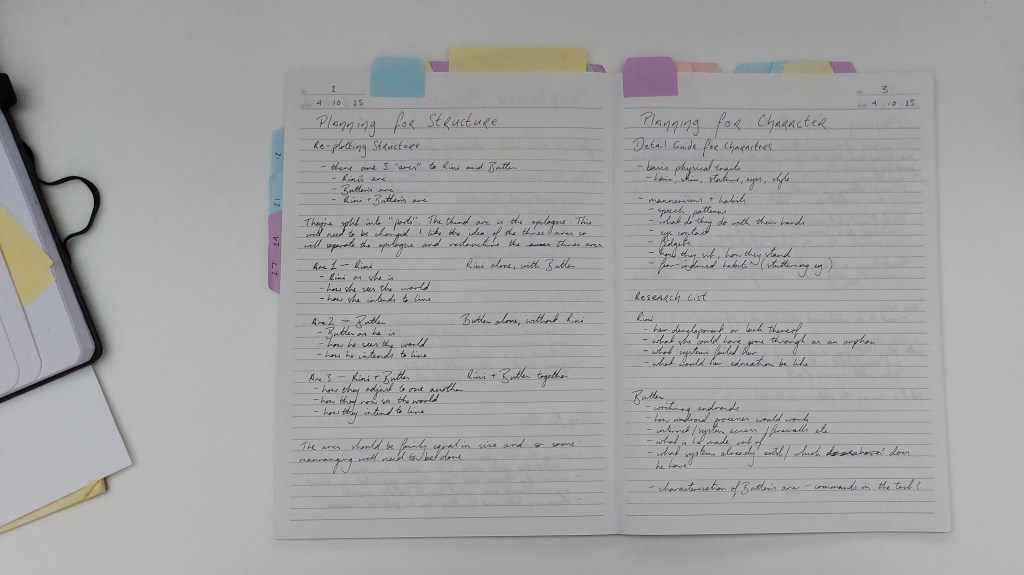
- plot the 2024 manuscript and then pull it apart to re-plot in a manner that fixes any structural or plot issues
- review the characters in the world and improve iterations to create more substance to them
Because I already had a completed manuscript for Rini & Butler, preparing for it was really more about ensuring that a fresh take occurs during the writing, that I would be guided by the manuscript but rewriting from scratch. I created a brand new Scrivener project for it, had the 2024 version with me but also focused on the new tools that I was implementing.
The Scene Folder: [Spoilers Ahead]
The scene folder was helpful in so many ways!
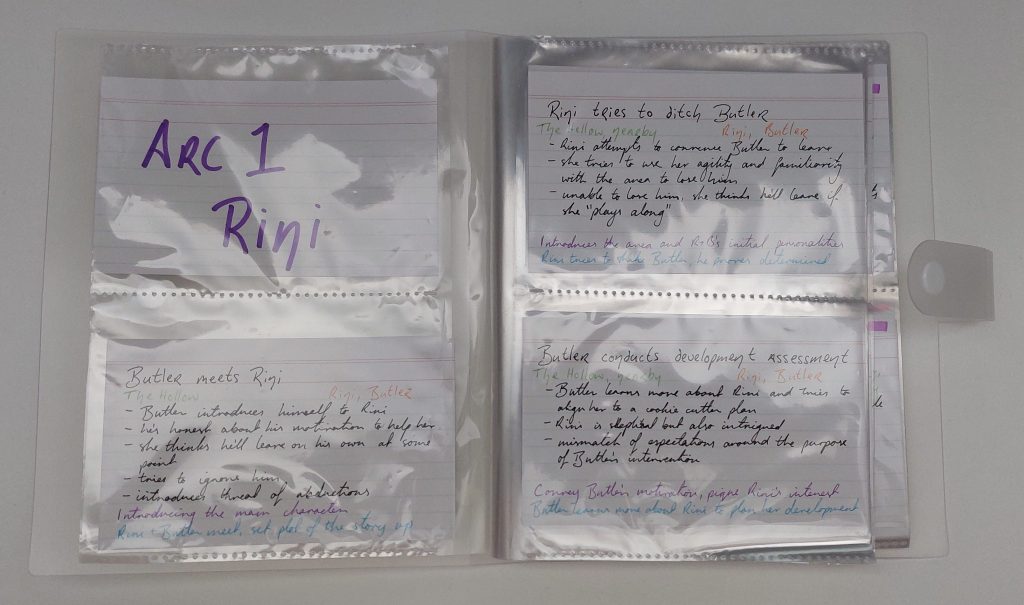
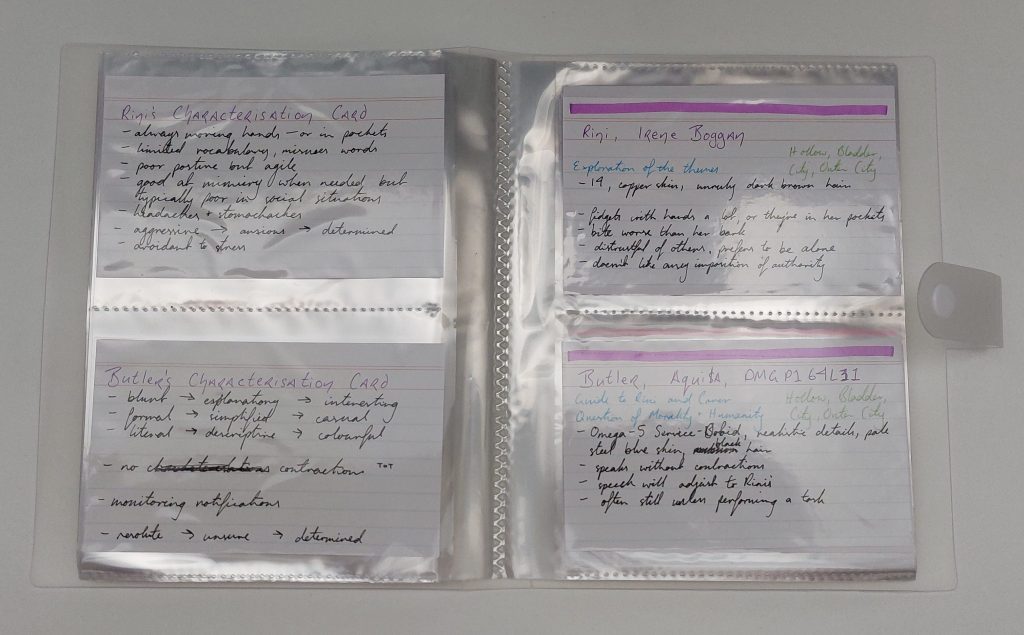
- it meant I had a clear visual representation of the plot that I could touch and move with my hands
- it helped me look at the key components of each scene and compare them to other scenes and expectations
- did they lack anything?
- did they have too much of something?
- it helped me visualise pacing and time
- it was fun to put together and I love any excuse to use stationary
The Scrivener Plotting Table
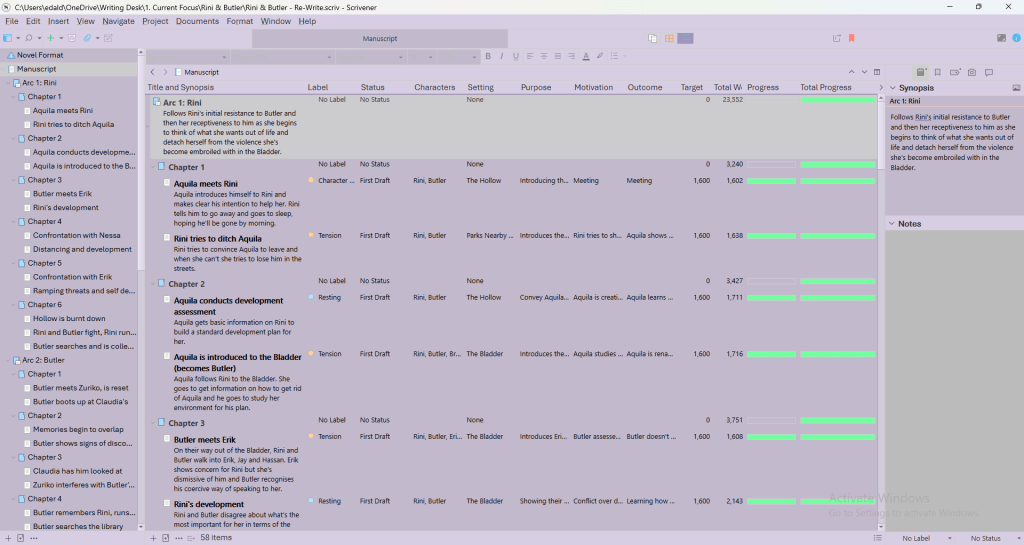
I while ago I found this video Advanced Outlining in Scrivener by J. Zachary Pike, I took the scene folder I’d learned from Heart Breathings and essentially digitised it so I could flick between a digital version and a physical version, as well as utilising the word count targets to keep the scenes consistent and show my progress during Writvember.
The Editing Guide
The editing guide pages for Preptober kept me on track and I made good use of the to-do lists and focuses.
November, 2025: Writvember
This Writvember went much more smoothly than I expect future Writvembers to go considering I had a full manuscript I was working with. That means that Preptober will be much more important and busier for the next round. I do plan on dusting off my bigger and older projects and renewing them with the writing blocks so it might not be too bad.
The Editing Guide
The editing guide kept me on track but I don’t think the weekly pages will be necessary next time as there wasn’t a need for the to-do list.
January, 2026: Prepuary
After a break through December, I started Prepuary in January. Prepuary is designed to be preparation for editary and so a cursory edit and a log of areas that need to be looked at closely during the refined edit in February.
I printed out a physical copy, binding it together for a physical mark up run through to guide me for Editary. I didn’t spend the time actually binding it with thread and glue (I used staples and tape) and came to regret that later.
What I was looking for in Prepuary:
- inconsistencies to iron out
- such as time, descriptions or names
- glaring errors such as basic typos
- areas of improvement to be rewritten or added during Editary
- when I edit, I often get a “vibe” that something doesn’t work
- when I don’t know how to resolve it immediately, I underline it with a squiggle, add comments and really work it over during the next edit
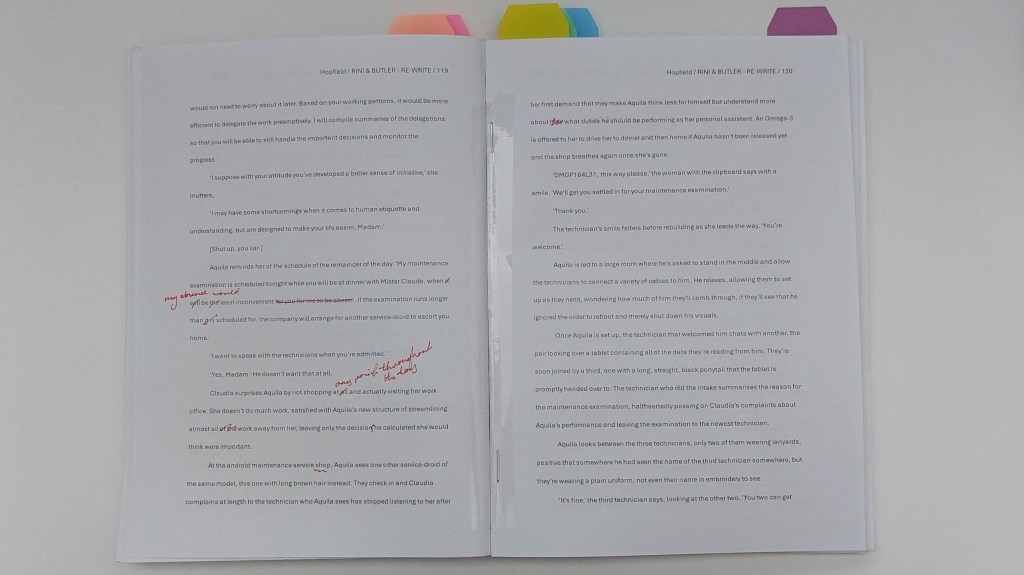
In hindsight, Prepuary could have been completed in two weeks and the remainder of the month allocated to Editary.
February, 2026: Editary
Editary saw a focus on the second half of part two and part three as they were the new writing sections. The first part and much of the first half of the second part hadn’t changed much from the draft before hand.
I was combing for errors and inconsistencies. Scrivener doesn’t have as good as a checker as Microsoft Word so I really only had my marked-up printed copy to guide me … I still missed errors (⌒_⌒;)
But it felt good to get to the end of the edit. I will be writing more about the journey it took to get to this point and where I’m going from here, but for now I thought I would give this update before it’s two months overdue (〃 ̄ω ̄〃)ゞ

 Hopfield is Writing
Leave a comment