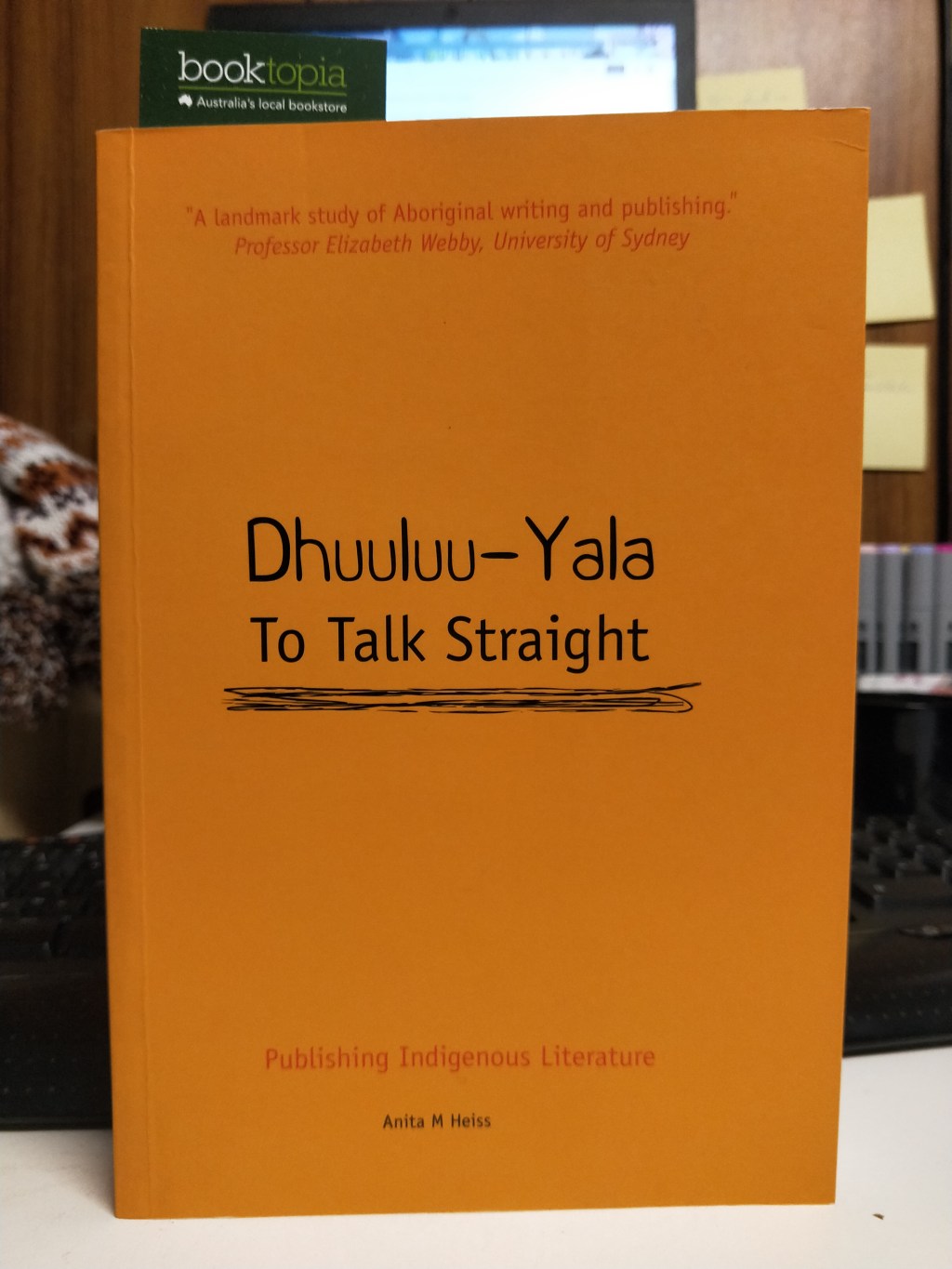
Throughout my Indigenous Knowledge Minor, there has one book that I have used in almost every single assessment task as a reference because it’s my go-to for how I, as a writer, can do my part as an ally to Aboriginal and Torres Strait Islanders. It’s a bit more complex than that but that’s for another project that I’m working on. For a brief explanation: the Indigenous Knowledge Minor constantly had us questioning where we stand in our professions and our cultural interfaces and how we can utilise what we have to support Indigenous Australians and help decolonise Australia. Being a writer, I looked for specific texts about the Australian publishing industry in regards to Indigenous Australian work and how it is affected by these systems. That’s when I found what has since been my foundations for thinking about how I as a writer can engage in my writing as an ally: Dhuuluu-Yala: To Talk Straight by Anita Heiss.
This book is important for a vast number of reasons but I’ll break up the first two that struck me because I want you to read the rest for yourself. If you are a non-Indigenous Australian author and truly want to support Indigenous Australian people, authors, artists and the like, then this book is invaluable.
- Systematic Racism in the Publishing Industry
- Where do Allies stand in Indigenous Writing?
1. Systematic Racism in the Publishing Industry
In the beginning of the novel, Heiss outlines a few of the issues that Indigenous Australians face against the Australian publishing system, and it’s fairly similar to the issues that First Nations People face in most Australian systems. Whether it’s neglect or just undervaluing the work produced by Aboriginal and Torres Strait Islanders, the publishing industry has a shown a bias towards western works (pg. 12). Though I started reading the book with an understanding that most systems are white-dominant, I was shocked (but not surprised in a way) to learn about the controversies surrounding non-Aboriginal people writing under the guise of an Aboriginal persona (Heiss discusses ‘Wanda Koolmatrie) (pg. 2). But it doesn’t just happen in the writing industry, Australia has a long history of plagiarising/exploiting Indigenous Australian culture (and people). I have been wary of it for much of my life (my stepmother is Indigenous Australian and so is my elder sister and so though I wasn’t well-informed, I had a vague understanding of the wrong treatment of First Nations People) but in the last four years I have been careful about supporting Indigenous art and writing actually created by Indigenous Australians. It’s important to do some research to make sure you are supporting the people who are the owners of the content/culture. Bundarra and Clothing the Gap are two Indigenous Australian owned and managed stores that I’ve bought from and would recommend.
When reading this text, it becomes more and more obvious as to what I already knew, which is a strange idea. There’s a lot that I ‘knew’ but really didn’t ‘know’ and Heiss really gets you thinking about the depth of issues that might just be glossed over when you first hear about it. It’s the difference between knowing something is ‘bad’ to recognising that there are many ugly roots supporting that ‘bad’. It’s not enough to know it’s bad, you need to understand why it is so you can find out how you can help uproot it and dispose of it.
I studied Australian Literature as one of my units in my degree and the idea was to shed light on Australian authors, specifically local. I never read based on where the author was from, it didn’t matter to me as I grew up. I read stacks of fantasy and whatever I thought I would enjoy consuming and so the unit made me think about needing to support Australian voices… but Aboriginal and Torres Strait Islander voices were glossed over, and I only realise that in hindsight. Had I not been studying the Indigenous Knowledge Minor, had I not been reading through Dhuuluu-Yala: To Talk Straight, would I have even noticed? From this, and looking at all of the referenced material in this text and also during my assignments, it became clear that it’s not a lack of Indigenous writing in the market, it’s a lack of spotlight and support for those works by publishing companies (pg. 90) who might not have a single Indigenous Australian amongst their staff (pg. 2). The impact of non-Indigenous Australians editing and choosing Indigenous Australian work is substantial (pg. 70). Do you think it makes sense for a team of Swedish editors to edit a work written by a Vietnamese person?
2. Where do Allies stand in Indigenous Writing?
We stand where they tell us to stand. Plain and simple.
One of the most important points that I took from the text in the first few chapters is that it is not up to me to decide where I stand as an ally, it’s up to me to do my due diligence and understand where I need to stand. Throughout reflection in the Indigenous Knowledge Minor I worked by the idea of: I need to not be the voice but be the megaphone when it comes to Indigenous Australian voices. There’s a complexity to a non-Indigenous Australian ally relationship with Indigenous Australians because uninformed ideals can lend to ideas of ‘helping’ and ‘care’. ‘Paternalism’ is how white Australia has been trying to ‘help’ Aboriginal and Torres Strait Islanders. The idea that non-Indigenous Australians need to ‘take care of’ Indigenous Australians is something that people need to put in a garbage bag and put on the side of the street on bin day. The lectures and tutors of the units I have been studying place great emphasis on need to decolonise the idea non-Indigenous Australia has of Indigenous Australians. To sum the teachings, ‘we do not need your help, we are not incapable, we need your support and for you to teach other non-Indigenous Australians to decolonise their minds’. And that’s the same point that Heiss makes. The section Whites Writing on Blacks (starting from page 10) discusses the duty and controversy of non-Indigenous writers using Indigenous culture and themes in their works and the different sides of each argument. There is a need for great consideration towards ensuring that Australian writing is inclusive and honest but also not stepping over that line of exploiting or misrepresenting the ancient culture that resides in this soil (pg. 83).
There can be a difference in motive when a non-Indigenous Australian uses the culture of First Nations People in there work: striving to be inclusive or exploiting. Though there can be different intents, they can have the same affect. Simply ‘meaning well’ is not enough. These are stories that need to be told by Indigenous Australians because they are their stories. This section more or less taught me that my intention to include Aboriginal and Torres Strait Islander themes because of my interests or motives would replace a voice that should be talking about them. I finished a novel last year and it is one of my proudest works, but it cannot be published as it is and needs to be completely rewritten. My protagonist is/was Noongar and I found a beauty in using white ochre to display magic in her skin, but after reading this text, I scrapped it. I felt that I was doing my due diligence by studying about Noongar culture as much as I could but at the end of the day, it’s not my story. I have also used Japanese elements but I won’t be changing these because there’s a difference in using threads of culture and history from around the world and using the culture of First Nations People here in Australia, for more reasons than years I’ve been alive.
So, where so non-Indigenous Australians stand as allies? Where Indigenous Australians ask us to stand. Because that position is informed by Aboriginal and Torres Strait Islanders and you cannot support anyone if you don’t join in the discourse.
Don’t replace a voice, elevate it. This is the reason I only share tweets that concern issues such as Black Lives Matter, Closing the Gap, Pay the Rent, Stop Deaths in Custody etc. It’s not currently my place to write about how I ‘feel’ on these matters and so I only write on what I’ve learnt or when I’m supporting/protesting, sharing the tweets of Black Indigenous People of Colour.
And, just quickly, it’s not just about being ‘white’. I am a proud Tongan/Samoan/Swiss/Australian mash-up and I must still do my part as a non-Indigenous Australian.
This book is Publishing Indigenous Literature 101 and should be a prescribed and studied text in the writing degree. It is about First Nations Literature by a First Nations Person. The book was published 2003 and it’s really a shame that it’s 2020 and not a single unit in my writing major touched on it. A shame… really more of a disappointment. The more I studied and reflected in the Indigenous Knowledge Minor, the more I could see the prevalent issues everywhere around me, even in my own degree. My Major is Creative and Professional Writing, and there is not one unit dedicated to Indigenous Publishing.
The bibliography is about ten pages long and will help pave the path that this text will set you on your way. I got my copy from Booktopia Australia but originally was borrowing it from my uni library.
Read it. Learn from it. Utilise it.
Heiss, A. Dhuuluu-Yala: To Talk Straight. 2003. Aboriginal Studies Press: Australia, Canberra.

 Hopfield is Writing
Leave a comment