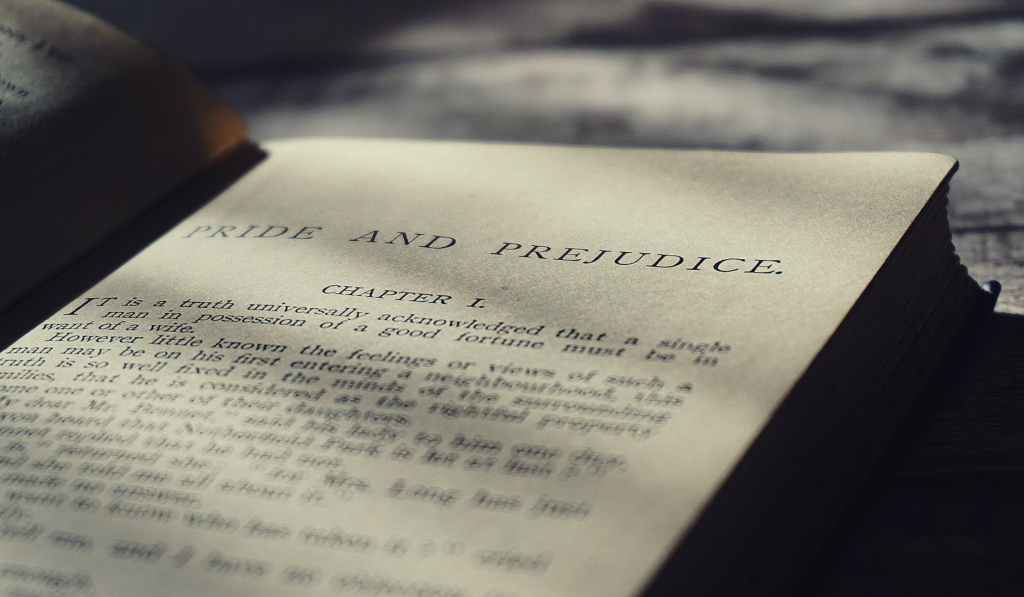
I’m more than halfway through Pride and Prejudice now and it is still a shorter list of whom I like in the novels than who I dislike. Though the novel is heading in the direction that I thought it would, it’s getting there in a vehicle different to what I imaged. I’ll keep my observations in dot point to avoid rambling, but cannot promise there will be none.
There will be spoilers. If you have not finished reading it and don’t want to know anything past the halfway mark, hit that ‘back’ button in your browser.

- Mr Collins sits up with Mrs Bennett as my most disliked character. The scene in which he proposes to Elizabeth (and the few chapters following) had me wanting to dive into the book and tear his face off. Although, perhaps Mrs Bennett outranks him here because I don’t mind if Mr Collins is happy (mostly for Charlotte’s sake) but I don’t want Mrs Bennett to be happy at the end. I’m petty like that to poor parental characters
- I like Mr Bennett and Charlotte Lewis, finding the pair of them clever and making the most out of the bunch of cretins around them
- Jane is Pride and Prejudice‘s Elinor: the character who has caused harm to no one but others will freely cause harm to
- I’m surprised there wasn’t more between Elizabeth and Mr Darcy. They don’t see each other for months and then he rocks up with a smooth confession (which he promptly ruins, regardless of whether Elizabeth was going to chew him out or not). I think this is just part of the style, and think that this is the reason why I have so far enjoyed Austen’s writing. Because, though they are romance, the romance isn’t entirely forefront. The passive aggression and wit of conversation are entertaining with the sappy regards to love being left to the side characters
- I actually liked reading Elizabeth fret over the letter Mr Darcy gave her because, quite frankly, she did deserve it. I never liked Mr Whickam (probably because I already had the OTP in mind) and her blatant defence of him seemed strangely foolish considering her character
- I’m not impressed with Mr Darcy’s development so far, though it is probably realistic. Whilst I originally thought that Elizabeth would soften him and his character would become less proud/abrasive, it hasn’t happened thus far and some of the things that come out of his mouth should be shoved right back in. But I imagine it was probably normal for that time
- Did I mention that I loathe Mrs Bennett?
- Charlotte’s ‘arc’ is admirable and kind of sad. I feel happy that she got what she wanted and put one up on Mrs Bennett but at the same time… it’s Mr Collins. But again, probably normal for that time
- I do like their aunt, Mrs Gardiner
- I’m confused as to who Fitzwilliam Darcy is; is it Mr Darcy or is it Colonel Fitzwilliam? Do they just share the same name?
- I kind of like Lady Catherine, mostly because she reminds me of Dame Maggie Smith’s character in Downton Abbey (just a little)
- Sometimes I wonder if Austen ever had any drafts of raunchy scenes that she kept to herself
- I often find myself translating passages into “contemporary” speech. If there is a version like that, and it’s funny, please let me know
- E.g. “And of your infliction,” cried Elizabeth with energy. “You have reduced him to his present state of poverty, comparative poverty. You have withheld the advantages, which you must know to have been designed for him. You have deprived the best years of his life, of that independence which was no less his due than his desert. You have done all this! and yet you can treat the mention of his misfortunes with contempt and ridicule.”
- Translation: “You’re a piece of shit.”
- E.g. “For heaven’s sake, madam, speak lower. — What advantage can it be to you to offend Mr Darcy? — You will never recommend yourself to his friend by so doing.”
- Translation: “Bitch, shut yo ass up.”
The Shade of it all.
My expectations for the remainder of the novel are simple and now do contain desired romantic resolution. My main motivation is that I would like all evil undone for Jane, and for Elizabeth to conquer the story and have her happy ending. Happy endings might be cliche, but sometimes we only get to read about them, that’s why they’re there.
- I want Mr Darcy to clean his act up a little and though I don’t want there to be a ‘hop, skip and a jump’ and he and Elizabeth are engaged or married, I would like to see development towards that by the end, even if its just a significantly more amicable relationship
- I want Mr Whickman to be shamed for being a general douchebag
- I want Jane to be happy, whether or not that includes Mr Bingely, I actually don’t care. Just leave her alone plz
- I would like Miss Bingely shamed properly
As you can see, Austen’s novels incite pettiness within me. But that’s okay, because they’re not real people.
*insert witch cackling here*
From reading Sense and Sensibility and now reading Pride and Prejudice, I don’t think I have ever read the works of a single author who continuously gives me a character lineup, of the majority which I really don’t like. By the first few chapters in both books, I was saying to myself “alright, I hate everyone here except these two people and that shop keeper”. Though I might have initially thought that I wouldn’t read books like that, it sets up an excellent drama where I’m just starved for all of these annoying characters to get their “just desserts”.

In Pride and Prejudice, I’m actually interested in Mr Darcy becoming Elizabeth’s partner, mostly because of the developments between them (and that sweet sweet tension), whereas in Sense and Sensibility, I had candidates for Elinor (meaning characters who I actually liked) but I didn’t see her with any particular one. But this doesn’t mean I would like to let them get together as is. I have a problem with romance novels glorifying “broody” characters, palming off their rudeness as part of a charm that attracts the other party. I don’t think Elizabeth is going to take his shit if they get married, and so he will have to have some personal development first. Sure, he’s right when he says her family are a bunch of weirdos, but the “I love you, and it was a hard conclusion to come by because your poor and your family is stupid” really isn’t something you say during a proposal. I was actually so excited at his declaration… and then he rambled about how it grieved him *facepalm against table*. But, I must admit, it was a lot better than Mr Collins’ damned proposal. I wanted to tear the pages out and eat them.
I think what I hated about Mr Collins’ proposal is that it was a clear reflection of one of the big problems about the mistreatment of women, and though the scene was angering and cringe-worthy, it was important. She said ‘no’ and he interpreted it as ‘hehe, I’m shy, keep chasing me’. This is a mindset that is ignorant and dangerous and is often used as an excuse by men who sexually assault women (or even vice versa or same-sex) and it’s not okay. I feel like this is one of the things that really bring feminism to light in a clever and rational way in the novel. It doesn’t scream political/cultural agenda but shows bluntly the behaviours that should be condemned as ‘normal’. I think that’s also why I hate Mrs Bennett so much. The fact that she couldn’t respect that her daughter said ‘no’ just irked me because it told all of the girls that they don’t get the right to say ‘no’. And though Mrs Bennett’s focus was probably just on securing home and fortune and bragging rights, it’s one of those small behaviours that people overlook because it’s not “overtly dangerous” but has long-term implications.
I’ll leave it there before I start to ramble on and will perhaps write a separate piece where I analyse what I believe to be aspects of the novel important to a feminism message. That will probably be mostly an opinion piece as much can be left up to interpretation and I may under or over-read into it, but I think it’s important to explore the themes of novels as they pertain to yourself as a reader. Not like in an English class where they tell you what you are to perceive the meaning as.
That’s about all I have to say on the book so far. Just a raw running commentary on my reading, basically. I am enjoying the novel overall and though I thought I had the plot figured out, I think Austen is going to surprise me with the ending.

 Hopfield is Writing
Leave a comment